
Greenwashing in Baby Products: Why This Campaign Matters for Parents and Children’s Health
Share
I didn’t get into skincare to “join a movement.” I got here because I couldn’t ignore what I saw.
Years ago, my life revolved around trying to conceive, IVF cycles, loss, recovery, and the emotional chaos that comes with all of it. When your body becomes the centre of so much hope and disappointment, you start reading labels in a completely different way. Not as marketing. As risk assessment.
That’s where skincare stopped being skincare for me.
It became biology, inflammation, exposure, and trust.
Why this partnership matters to me
My work with Obvs Skincare has always started from a simple idea: skin deserves formulations that support it without introducing unnecessary burden. Especially for people dealing with eczema, acne, sensitivity, or hormonal disruption.
But the more I learned, the clearer something became. The problem doesn’t start at the moisturiser. It starts much earlier, in the everyday environment around babies and children.
Nappies. Wipes. Toys. Nursery furniture. Even the air fresheners in a “safe” home.
A huge number of these products still contain synthetic chemicals, fragrance blends, preservatives, and mineral oil derivatives that sit comfortably in regulation gaps while families are told everything is fine.
It’s not fine.
That’s why partnering with the Green Baby campaign through Women’s Environmental Network matters so much to me. Their work with the Green Baby Campaign focuses on something I care deeply about: reducing exposure to harmful chemicals in everyday products and making that information accessible, not buried in tiny print or disguised behind “clean” marketing.
You can read more about it here: Green Baby Campaign – WEN
The uncomfortable truth about “baby safe” marketing
Parents are one of the most heavily targeted groups in consumer markets. And I understand why. When you have a newborn, you want reassurance. You want safety. You want simplicity.
That’s exactly where greenwashing thrives.
Words like “natural,” “gentle,” and “dermatologically tested” get used as emotional shortcuts. Meanwhile, formulas can still contain mineral oil derivatives like paraffinum liquidum, synthetic fragrance blends, formaldehyde releasers, and preservatives linked to irritation or endocrine disruption.
The issue is not just individual ingredients. It’s cumulative exposure.
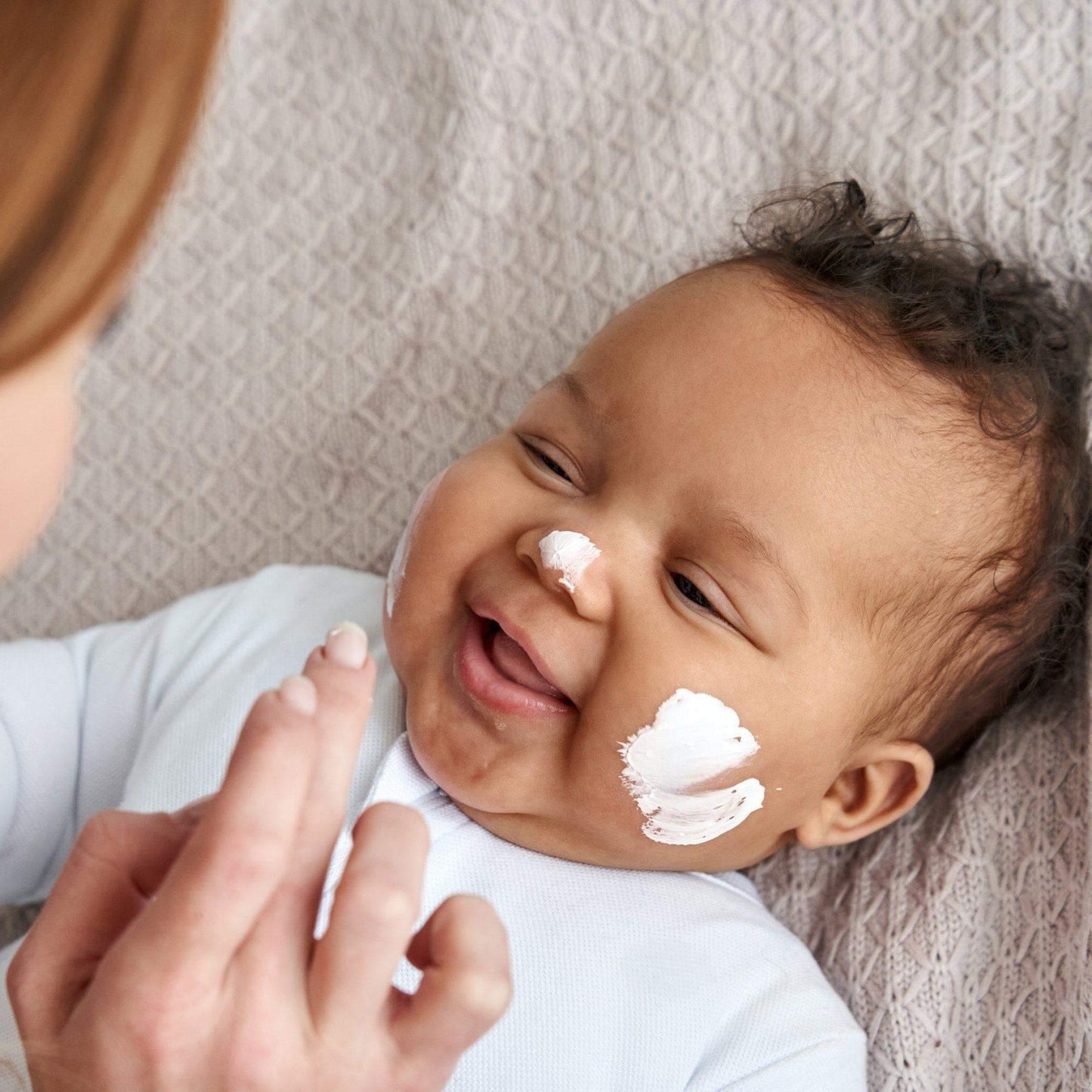
Babies and young children absorb proportionally more through skin contact than adults. Their systems are still developing. Their detoxification pathways are not fully mature. And yet they are surrounded by products designed without that reality at the centre.
This is where awareness changes everything.
Why paraffin is part of this conversation
Mineral oils such as paraffinum liquidum are still widely used in baby and sensitive skin products because they are cheap, stable, and create an occlusive layer on skin.
But they are also petroleum-derived.
They don’t nourish skin. They coat it. And while that might temporarily reduce moisture loss, it doesn’t address underlying skin function. In some cases, it can disrupt the skin’s natural balance over time, particularly in already compromised skin.
This matters more when you’re talking about babies, or adults navigating eczema, hormonal shifts, or inflammatory skin conditions.
My story is part of this work
When I went through IVF, I became hyper-aware of anything that might add to hormonal load or inflammatory stress in the body. It wasn’t paranoia. It was attention.
That period reshaped how I formulate everything in Obvs Skincare. Not from fear, but from a desire to reduce unnecessary exposure where possible and focus on ingredients that actively support skin barrier function.
That same thinking extends naturally into baby care.
Babies don’t need complexity. They need safety, transparency, and formulas that respect how delicate their systems are.
Why I will call things out
There’s a fine line in this industry between education and comfort. I’m not interested in softening language just to make brands feel better about their ingredient decks.
If a product is marketed toward vulnerable parents while containing ingredients linked to irritation, hormone disruption concerns, or environmental accumulation, that deserves scrutiny.
Not outrage for the sake of it. Accountability.
Because most parents are not failing to choose well. They are being sold incomplete information.
What this collaboration is about
Working with the Green Baby campaign is about shifting that imbalance.
It’s about:
- Making chemical exposure in baby products easier to understand
- Supporting parents with clearer information, not marketing noise
- Encouraging stronger regulation across the industry
- Highlighting how environmental and skin health are connected
- Creating space for honest conversations between brands and families
This is not about fear. It’s about clarity.
And clarity gives people power.
A future that feels different
I want a world where “baby-safe” is not a claim, but a standard. Where parents don’t need to become ingredient detectives. Where transparency is the baseline, not a marketing angle.
That future requires pressure from every direction: science, regulation, advocacy, and businesses willing to say uncomfortable things out loud.
That’s what this partnership represents for me.
Join the conversation
The Green Baby campaign is hosting a webinar on 18 June 2026, bringing together experts, organisations, and businesses working towards safer, more transparent standards for children’s health.
It’s a space for education, evidence, and action.
If you care about what goes on your baby’s skin, or what enters their environment day to day, this is worth your time.
Change doesn’t start with perfect products. It starts with informed questions.
And those questions are long overdue.
Sign up for the free webinar here - SIGN UP
P.S. Look for the #notonourbabies hashtag on socials for more info